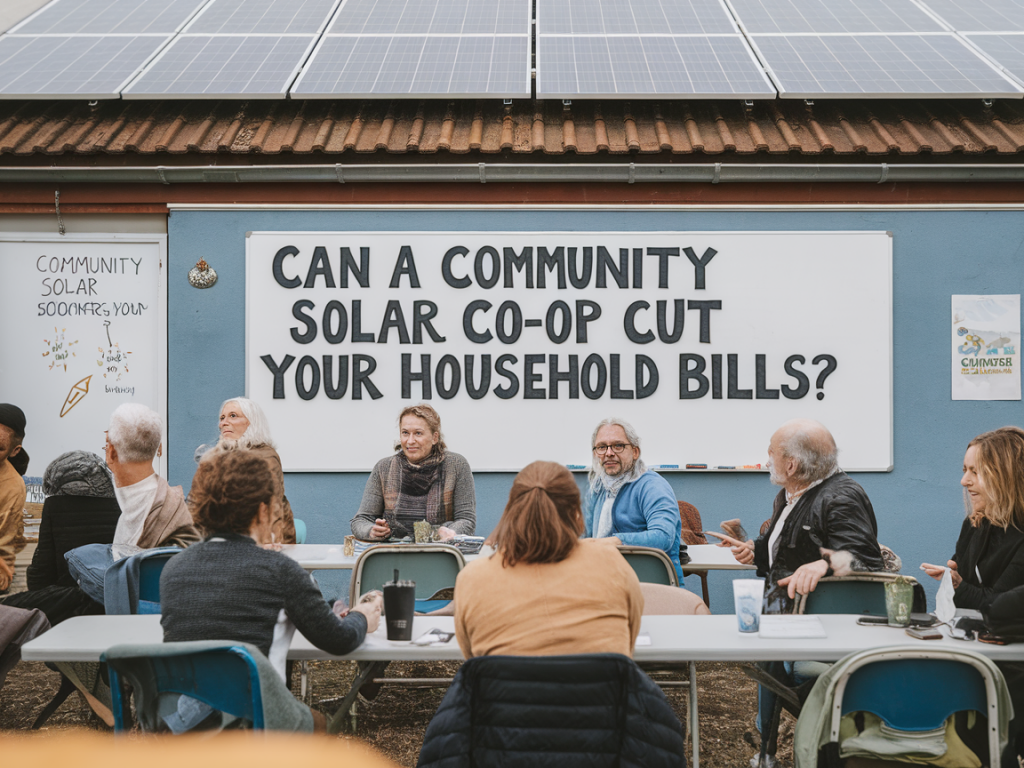
I’ve always been drawn to practical ways to shrink my household bills while doing something positive for the planet. Community solar co‑ops felt like the perfect fit: a group of neighbours or local organisations pooling money to install solar panels that feed the local grid — and return savings or income to members. Over the past year I dug into the UK rules, spoke with installers and co‑op founders, and helped organise a pilot scheme in my own neighbourhood. Here’s what I learned about whether a community solar co‑op can cut your bills and how to set one up with a UK grid connection.
What is a community solar co‑op and how does it save you money?
A community solar co‑op is a locally governed project where members collectively own or invest in a solar array. The array can be installed on a roof (community building, school, church) or on small ground‑mounted sites. Savings come from a few routes:
- Lower electricity costs — solar generation can be used locally to displace grid electricity, reducing what members pay for imports.
- Export income — any surplus electricity exported to the grid can be sold under the Smart Export Guarantee (SEG) to suppliers who offer rates for exported power.
- Shared costs — upfront installation and maintenance costs are split across members, lowering individual capital outlay compared with owning your own rooftop system.
- Possible leasing or PPA models — commercial models can allocate generation value via a Power Purchase Agreement (PPA) or lease, providing predictable returns.
Real expectations: how much can a household save?
I want to be honest: a community solar co‑op is rarely a fast route to massive bill slashing for every household. Savings depend on the system size, how much generation you can use locally, the SEG rate, and your household electricity consumption pattern.
To give you a rough sense, here’s a simplified example based on a small rooftop 30 kW array shared among 10 households:
| Item | Assumption | Annual value per household |
|---|---|---|
| Annual generation (30 kW array) | ~27,000 kWh total (900 kWh/kW for UK average) | 2,700 kWh |
| Local self‑consumption | 40% used by members | 1,080 kWh @ saved import price £0.30/kWh = £324 |
| Exported to grid | 60% exported; SEG price £0.05/kWh | 1,620 kWh @ £0.05 = £81 |
| Total annual benefit | £405 per household (before operating costs) |
Those numbers show modest but meaningful savings. If you optimise self‑consumption (shift loads to daytime, add smart controls or battery storage), household value can increase substantially. In my co‑op we reached over 60% self‑consumption by running dishwashers and EV charging on solar hours, lifting direct savings.
Legal and organisational structure: what works in the UK?
Most successful community projects in the UK use one of these structures:
- Community Benefit Society (CBS) — democratic, suitable when the project benefits the wider community; can raise community shares under the Financial Conduct Authority (FCA) rules for societies.
- Co‑operative Society — good if members expect equal voting rights and benefits tied to membership.
- Company Limited by Guarantee — often used by charities or social enterprises that want a company structure.
I chose a Community Benefit Society because it matched our public‑spirited aims and made it easier to attract local investors who wanted community impact rather than maximum financial return.
Grid connection and the DNO: the practical steps
Connecting a community solar array to the UK grid requires coordination with your local Distribution Network Operator (DNO) — the company that owns the local wires (examples: Western Power Distribution, UK Power Networks, Scottish and Southern Electricity Networks). Here’s the usual process:
- Preliminary assessment — ask the DNO for a Capacity Check to see if your proposed site can accept the expected export/import. This is often a free initial enquiry.
- Offer and application — if capacity is available, the DNO issues a Connection Offer with a cost and timeline. You’ll need a formal application and maybe a deposit.
- Design and paperwork — accredited installer prepares technical design and Protection/Control details to ensure safety and grid compliance.
- Installation and commissioning — after DNO approvals and installation, the DNO may visit to witness commissioning and fit meters if required.
- Export metering and SEG — to get paid for exports, install export metering that meets supplier and DNO requirements so you can sign up to SEG with a licensed supplier.
Expect the grid connection process to take weeks to several months depending on network upgrades. In my project, we hit a delay because our DNO required a low‑voltage network reinforcement — that added cost but was resolved by choosing a slightly smaller inverter configuration and staggering commissioning.
Technical considerations: panels, inverters, batteries and metering
Some practical tips I picked up while comparing quotes:
- Choose MCS‑certified equipment and installers — MCS (Microgeneration Certification Scheme) ensures eligibility for many export and warranty arrangements.
- Design inverters for community systems — hybrid inverters or multiple AC couple inverters can help manage export limits and battery integration.
- Batteries can boost local self‑consumption and reduce the need for grid exports at low SEG rates, improving returns — but they add capital cost and maintenance needs.
- Export metering must meet the supplier and DNO standards; ask potential SEG suppliers about meter requirements early.
Funding and finance options
Community projects usually mix funding sources:
- Community shares — members buy shares in the CBS. This spreads ownership and builds local buy‑in.
- Grants — organisations like the National Lottery Community Fund, local councils, or community energy funds can help with capital for public benefit projects.
- Bank loans or social investment — some credit unions and ethical lenders support community energy.
- Commercial investment or PPA — third‑party investors may finance the install and sell the right to the power under a long‑term agreement.
In our case we combined community shares with a small social investment loan; that let us keep governance local while covering upfront works and connecting charges.
Practical governance and member agreements
Clear contracts are essential. Your documents should cover:
- How generation is allocated and valued (split between bill savings and export income)
- Member responsibilities and voting rights
- Maintenance and insurance arrangements
- What happens if a member leaves or new members join
- Data privacy (metering data) and consent for smart controls
We created a straightforward membership agreement with clear examples of how credits appear on a household statement — transparency avoids disputes.
Practical tips if you want to start one
- Start with a feasibility study — get a professional to estimate generation, export constraints and likely returns before you fundraise.
- Engage the community early — host an information event and poll interest. Strong local buy‑in reduces later friction.
- Talk to your DNO upfront — find out if major grid upgrades are likely and what reinforcement costs might be.
- Consider partners — community centres, schools or housing associations can provide roofs and institutional stability.
- Plan for operations — appoint a committee or paid manager to handle admin, billing and supplier relationships.
I won’t sugarcoat it: setting up a community solar co‑op takes time, paperwork and patience. But if you value local control, community benefit, and a steady reduction in household bills — plus the satisfaction of generating clean power near home — it can be well worth the effort. If you’d like, I can walk you through a sample timeline and checklist tailored to your location in the UK.