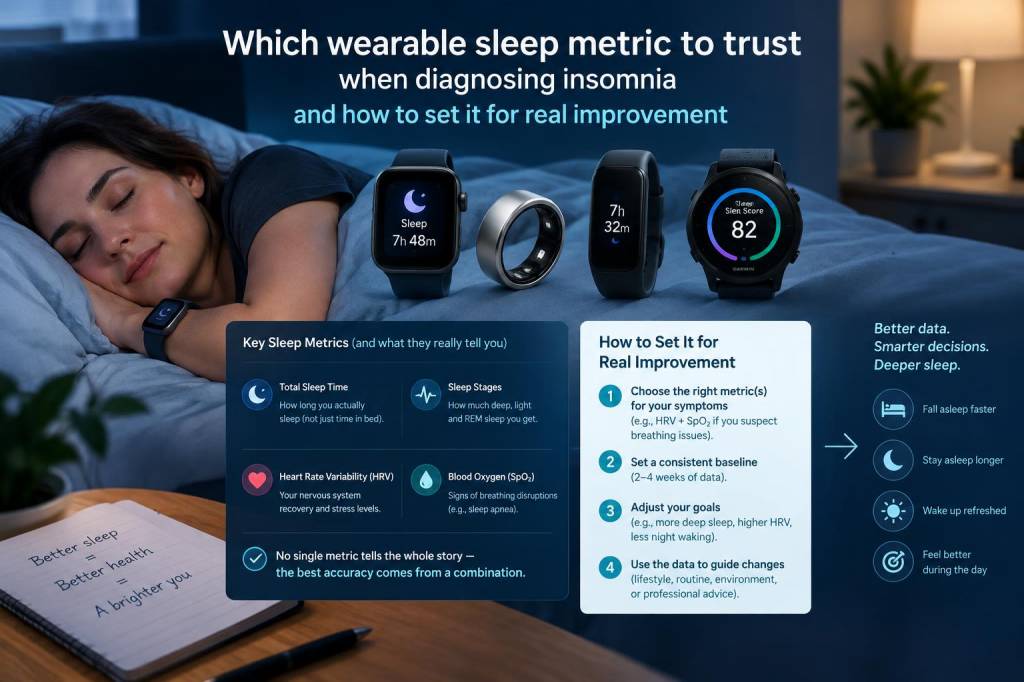
I started wearing a sleep tracker because I wanted proof that I was actually sleeping less than I felt I was. Like many of you, I wanted simple answers: am I falling asleep quickly? Am I waking up too often? Is my “poor sleep” just perception, or a measurable problem? After months of testing wristbands, rings and phone apps, talking to sleep clinicians and reading validation studies, I learned that some wearable metrics are useful for recognizing insomnia symptoms — and others are noisy, misleading or simply not designed for diagnosis.
What wearables can and cannot do
First, let’s be realistic: wearable devices are not replacements for a sleep consultation or polysomnography (PSG), the clinical gold standard. PSG measures brain waves, eye movements and muscle tone. Most consumer devices use movement (actigraphy), heart rate and algorithms to estimate sleep stages. That works well for some questions and poorly for others.
Here’s how I think about it: use wearables to track patterns and symptoms over time, not to deliver a one-off diagnosis. They’re excellent for spotting trends — later bedtimes, more night awakenings, longer time spent awake in bed — which are the same behaviors we target in cognitive behavioral therapy for insomnia (CBT-I). But if you have suspicious symptoms like loud snoring, choking, unexplained daytime sleepiness, or suspected REM behavior disorder, see a clinician.
Metrics I trust — and how to use them
Below are the wearable metrics I found most useful for identifying and monitoring insomnia-related problems, with practical thresholds and settings you can adjust.
- Sleep onset latency (SOL): This measures how long it takes you to fall asleep after turning out the lights. Actigraphy and heart-rate–based devices can estimate SOL reasonably well when you keep a consistent “lights out” signal (see settings below). If your average SOL is consistently >30 minutes, that’s a red flag for insomnia. For many people SOL > 20–30 minutes on multiple nights indicates difficulty initiating sleep.
- Wake after sleep onset (WASO): This is total minutes awake after initially falling asleep. Wearables typically detect movement or heart-rate changes to mark awakenings. Use WASO to spot fragmented sleep: >30–60 minutes per night on average suggests clinically meaningful awakenings. WASO is one of the most actionable metrics because CBT-I targets reducing night-time wakefulness.
- Sleep efficiency (SE): Calculated as total sleep time divided by time in bed. Good sleep efficiency is generally >85–90%. If your SE is consistently <85%, especially with normal sleep opportunity, that points to insomnia that may benefit from behavioral treatment.
- Total sleep time (TST): TST gives you an idea of sleep quantity. While wearables can under- or overestimate TST, trends across weeks are meaningful. If you’re consistently below your personal baseline (for example, trying to keep 7–8 hours but getting 5.5–6), that’s useful evidence to act.
- Heart rate and heart rate variability (HR, HRV): Night-time resting heart rate that is elevated versus your baseline can indicate hyperarousal, a core feature of insomnia. Low HRV overnight can also reflect stress and poor parasympathetic recovery. These aren’t diagnostic, but I use them as supportive signals when SOL/WASO/SE look poor.
- Sleep timing and regularity: Wearables do a good job tracking when you go to bed and wake up. Irregular sleep schedules are a common driver of insomnia-like symptoms, so I rely on device logs to spot inconsistent bedtimes and social jetlag.
Metrics I’m cautious about
Some metrics look impressive but aren’t reliable enough for diagnosing insomnia:
- Detailed sleep stages (REM vs deep sleep percentages): Devices vary widely in how accurately they classify stages. They can be helpful for broad trends (e.g., less deep sleep across a stressful week), but I wouldn’t use a single-night stage breakdown to make clinical decisions.
- Awakening counts: Many devices report dozens of short awakenings that may be normal microarousals. The raw count without duration context can be misleading. Prefer WASO (minutes awake) over sheer number of awakenings.
- “Sleep score” or proprietary indices: These marketing-friendly scores blend multiple signals and vary by brand. They’re okay for motivation, but don’t substitute for looking at the raw metrics that matter: SOL, WASO, SE and TST.
How to set your wearable to get useful data
After testing multiple devices (I’ve used a Fitbit, an Oura ring and a research-grade actigraph), the quality of data depends more on how you use the device than on the brand. Here are the settings and habits that made my tracking worthwhile:
- Set a consistent “bedtime” and “wake time” window: Many apps let you set a sleep window or manually tap “sleep.” Using this signal reduces false positives in SOL and WASO. If you can’t set a manual sleep marker, ensure the device’s auto-detection is calibrated by reviewing and correcting nights in the app.
- Enable high-sensitivity tracking if available: Some trackers have normal vs sensitive movement detection. For insomnia symptoms I switched to higher sensitivity to capture subtle awakenings — but be careful: higher sensitivity can also increase false awakenings.
- Wear the device consistently and snugly: Heart-rate and HRV measurements require a steady, snug fit. Rings like Oura are more consistent for HRV; wrist-worn devices sometimes lose contact during the night if loose.
- Sync and review nightly, but focus on weekly trends: Don’t obsess over one bad night. I review rolling 7- or 14-day averages to identify patterns and avoid catastrophizing normal variability.
- Log behaviors in parallel: Use the device’s journal or a simple sleep diary to note caffeine, alcohol, naps, screen time, stressors, and pre-sleep routines. This contextualizes changes in SOL and WASO and helps you identify triggers.
How I used wearable data to improve my sleep
When my SOL and WASO crept up, the wearable gave me evidence to change my approach. I used three strategy layers:
- Behavioral changes: I enforced a consistent bedtime/wake time, limited evening screen use, and moved evening exercise earlier. My devices showed SOL dropping from ~40 minutes to ~20 over two weeks.
- Sleep restriction and stimulus control: With guidance from CBT-I resources, I tightened my time in bed to raise sleep efficiency. The tracker’s SE and WASO metrics were invaluable to see the effect — SE increased and WASO decreased.
- Stress reduction and HRV: I practiced brief breathing and relaxation before bed; overnight HRV slowly improved, matching better SE and fewer awakenings.
When to see a professional
If wearable data consistently show SOL > 30 minutes, WASO > 60 minutes, or SE < 85% across several weeks despite behavioral changes, consider consulting a sleep specialist. Also seek help if you have intense daytime sleepiness, loud snoring with pauses, or other concerning symptoms. Wearables are a conversation starter — bring your exported data or screenshots to your appointment to make that conversation productive.
Quick reference: trust level by metric
| Metric | Trust level | How I use it |
| Sleep onset latency (SOL) | High | Identify trouble falling asleep; target with CBT-I strategies |
| Wake after sleep onset (WASO) | High | Measure fragmentation; guides interventions to reduce night wakings |
| Sleep efficiency (SE) | High | Overall sleep quality metric; good target for behavioral change |
| Total sleep time (TST) | Moderate | Track quantity and weekly trends |
| Heart rate / HRV | Moderate | Supplemental: indicates arousal/stress |
| Sleep stages (REM/deep) | Low–Moderate | Use for broad trends only |
| Sleep score (proprietary) | Variable | Motivational, not diagnostic |
Wearables gave me the evidence and confidence to change my habits and, more importantly, the language to discuss sleep problems with clinicians. If you’re using a tracker to investigate insomnia, focus on SOL, WASO, SE and consistent timing; use heart-rate metrics as supporting context; and remember that the goal is sustained behavior change, not nightly perfection.