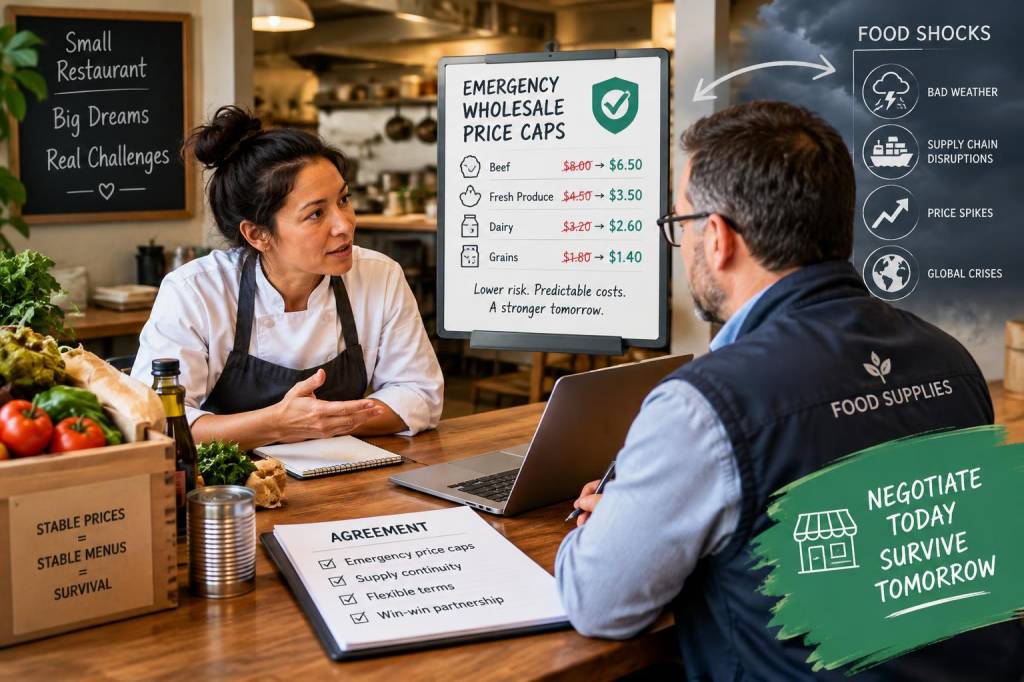
I remember the first time a sudden spike in tomato prices forced me to choose between keeping a classic dish on the menu and protecting my margins. That crisis taught me something important: small restaurants don’t have to be price-takers in a food shock. With preparation, clear communication and a willingness to negotiate, you can get suppliers to agree to emergency wholesale price caps that give you breathing room until markets stabilise.
Why negotiate price caps — and when to act
When a food shock hits (bad harvests, logistics bottlenecks, energy cost spikes), suppliers often pass costs straight down. For a small kitchen running thin margins, that can mean immediate menu changes, shrinking portions or worse. Asking for a temporary price cap isn’t a plea — it’s risk management. It helps you maintain menu consistency, protect customer trust and keep cashflow predictable.
You should start a negotiation when:
Prepare before you pick up the phone
Walk into a negotiation with facts and alternatives. Suppliers respect numbers. Here’s a checklist I use:
How to frame the conversation
Start collaborative, not confrontational. I open with a line like:
“We value our partnership and want to keep buying from you, but recent price moves threaten our ability to keep ordering at current volumes. Can we explore a temporary cap or tiered pricing for the next 8–12 weeks so we both avoid disruption?”
Key points to emphasise:
Practical cap structures that work
Suppliers may be open to different styles of caps. Here are structures I’ve negotiated that small restaurants can realistically propose:
| Cap Type | How it works | When to use |
|---|---|---|
| Fixed temporary cap | Set a maximum unit price for key SKUs for a specified period (e.g., 8 weeks). | When volatility is sharp and short-term. |
| Tiered cap by volume | Lower capped price if you commit to a higher weekly volume. | When you can ramp purchasing without overstretching storage. |
| Index-linked cap | Price is capped but adjusts only if a market index (e.g., wholesale tomato index) moves beyond an agreed threshold. | When you want fairness but need protection from small swings. |
| Deferred surcharge | Supplier adds surcharge now but defers part of it for review later; may be reduced if prices fall. | When supplier needs cashflow but you need immediate relief. |
Sample contract language
When they agree, put it in writing. Here’s concise phrasing I’ve used and adapted:
“Supplier agrees to cap the unit price for [SKU list] at £X per unit from [start date] to [end date] (the ‘Cap Period’). Buyer commits to purchase a minimum of [Y] units per week during the Cap Period. Any price increases beyond the Cap will be absorbed by Supplier unless publicly available market indices (e.g., [index name]) exceed [Z%] above the baseline for two consecutive weeks, at which point parties will reconvene to negotiate adjustments.”
Also include:
Levers you can realistically offer
Small restaurants don’t have the buying power of chains, but you can offer meaningful concessions:
When to seek collective solutions
If you’re in a cluster of independent restaurants, collective bargaining works. I’ve helped convene three local cafés to ask a regional wholesaler for a shared cap on eggs and dairy. It’s easier for suppliers to justify concessions when multiple consistent buyers are involved. Local trade associations or a hospitality business group can formalise that approach.
Operational moves to pair with price caps
Price caps buy you time — use it well:
Red flags and legal considerations
Watch for clauses that lock you in unreasonably. Avoid long automatic renewals or steep penalties for reducing orders. If a supplier asks for exclusivity or non-compete language, get legal advice — those can limit your supply options and hurt you long-term. In the UK, inform yourself about competition law if you’re forming buying groups; it’s fine to jointly negotiate terms but not to set resale prices or divide markets.
Sample negotiation script for a call
Use plain language. I start calls like this:
“Hi [Name], thanks for making time. I want to keep working with you — your consistency matters. With the recent price moves on [ingredient], we’re at risk of cutting classic dishes that customers expect. I’ve modelled a temporary cap at [proposed price] for the next [X] weeks, with a small increase in our minimum weekly order. That helps you keep volume and gives us predictability. Is that something we could explore?”
Listen more than you talk. If the supplier counteroffers, probe what they really need (cashflow, reduced deliveries, larger loads) and propose tailored concessions.
Keeping the relationship after the shock
If you get a cap, document performance: track on-time deliveries, quality and how often the cap was needed. After the period ends, debrief with your supplier. If the arrangement worked, propose a standing contingency clause for future shocks — a short, hot-swap playbook that both sides can trigger without starting from scratch.
I’ve negotiated caps with regional wholesalers like Brakes and smaller local growers, and the common thread is simple: suppliers respond when you respect their needs, come prepared, and offer practical trade-offs. In turbulent markets, that pragmatism keeps kitchens cooking and customers coming back.