I have seen invoice fraud work because it looks ordinary. That is what makes it dangerous. It rarely arrives as a dramatic hack or a loud warning sign. More often, it appears as a familiar supplier name, a routine payment request, and a sense of pressure to move quickly. For a small business, that combination can be costly. A fake invoice does not need to be perfect; it only needs to slip past a busy person for a few minutes.
When I think about invoice fraud, I do not think only about technology. I think about habits, trust, and fatigue. A supplier relationship built over months can be exploited with a single email. A finance team stretched thin can miss a tiny change in bank details. A founder who is trying to keep operations moving may approve a payment because everything feels normal. That is why spotting fraud before paying matters so much. It is not just about catching criminals after damage is done. It is about building a payment process that slows risk down enough for careful review.
Why fake supplier invoices feel convincing
Fraudsters study behavior. They know what a normal invoice looks like, what language businesses expect, and which moments are most vulnerable. I have noticed that fake invoices often mimic routine patterns very closely. They use a real company name, a logo copied from a website, familiar service descriptions, and an amount that does not look suspicious at first glance. Sometimes they even reference a recent project or a real employee name to create confidence.
What makes this so effective is that busy people do not always inspect every detail. If an invoice arrives at month end, matches an expected amount, and comes from an address that looks close to a legitimate supplier domain, it can easily be paid without a second thought. Fraudsters rely on this speed. They want you to react, not verify.
In my experience, the strongest defense starts with one mindset shift: every invoice should be treated as a claim, not a fact. An invoice says someone wants money. It does not prove they are entitled to it.
Signals I look for before any payment leaves the account
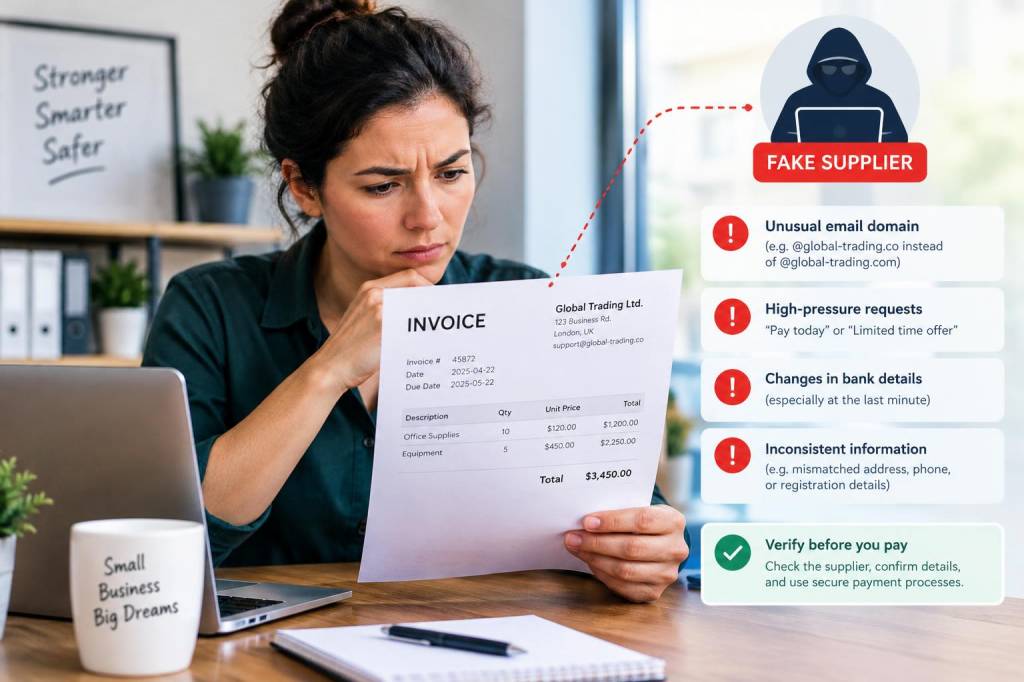
When I review an invoice, I do not look for one dramatic red flag. I look for small inconsistencies that do not quite fit together. A fake invoice often survives because each detail seems harmless on its own. Together, though, they can tell a different story.
- Bank account changes that arrive by email without a separate verbal confirmation
- Domain names that differ from the supplier’s usual email address by one character or one extra word
- Unusual urgency, especially language pushing immediate payment or warning of service disruption
- Payment instructions that differ from prior invoices for no clear reason
- Formatting oddities, such as inconsistent fonts, spacing, spelling errors, or low-quality logos
- Vague line items that do not match the actual work completed
- Invoices sent from a new contact when the business has always dealt with a different person
I also pay attention to timing. Fraud attempts often land just before a weekend, during staff absences, or in periods when the business is under pressure. If someone knows your team is busy, they may try to exploit that moment. A legitimate supplier usually understands that payment verification takes time. A fake one often wants to remove that time.
Verification habits that save money
I believe the safest businesses build verification into everyday routines. That way, no one has to rely on memory or instinct alone. A strong process does not need to be complicated. It needs to be consistent.
One habit I trust is out-of-band confirmation. If a supplier sends new bank details, I verify them using a separate channel. I call a known phone number from previous records, not the number on the invoice. I use a contact stored in our system, not the reply address in the email. If a request is real, the supplier should be able to confirm it through a channel we already trust.
I also like a two-person approval process for high-value or unusual payments. One person reviews the invoice, and another confirms the details independently. This matters because fraud often succeeds when one person is rushed or assumes someone else has already checked. A second set of eyes can catch what the first person misses.
Another useful habit is matching invoices against purchase orders, contracts, or delivery records. If the invoice says a service was provided, there should be evidence of that service. If the amount changed, ask why. If the scope is different, ask why. I have found that this simple comparison prevents a surprising number of mistakes, not only fraud but also honest billing errors.
| Risk signal | What it may mean | Action I would take |
|---|---|---|
| New bank details | Possible account takeover or impersonation | Confirm by phone or known contact |
| Urgent payment request | Pressure tactic to skip review | Pause payment until checks are complete |
| Email domain change | Lookalike address may be fraudulent | Compare against saved supplier records |
| Invoice mismatch | Wrong amount or fake service claim | Reconcile with order, contract, or delivery proof |
| Unexpected contact person | Possible impersonation | Verify identity through trusted channels |
Small details that deserve extra attention
I have learned that invoice fraud often hides in plain sight. A tiny spelling change in an email address can be enough to fool a rushed reader. A bank account number that differs by a few digits can redirect a payment instantly. A logo copied from a website may look close enough to pass if no one zooms in. These details matter because fraudsters count on visual recognition. They want you to think, “I know this supplier,” before you have actually checked.
One area I never ignore is payment destination. If an invoice asks for funds to go to a personal account, an offshore account with no clear business link, or a new account in a different country, that deserves a pause. A genuine supplier should have a reasonable explanation, and that explanation should be documented. I also become cautious when an invoice comes from a free email service rather than a business domain. That does not prove fraud on its own, but it weakens confidence.
I am equally careful with attachments. Some fake invoices are harmless-looking PDFs, but others are delivery vehicles for malware or link-based scams. If a file arrives unexpectedly, I check the sender, scan the attachment, and compare it against the supplier’s usual format. A secure payment process is not only about preventing fake transfers; it is also about protecting systems and credentials.
What I would build into a payment process
If I were setting up a payment process for a small business from scratch, I would keep it simple and strict. I would rather have a process that is easy to follow every day than a complicated one that people ignore when they are busy. I would want clear ownership, visible records, and a shared understanding that speed never outranks verification.
- Keep a verified supplier list with saved contact details
- Require independent confirmation for bank detail changes
- Match invoices to orders, contracts, or completed work records
- Use dual approval for unusual or high-value payments
- Review invoice formatting, sender details, and account information before release
- Train staff to pause whenever pressure, secrecy, or urgency appears
- Document every change to supplier payment instructions
I would also make sure people know who to ask when something feels wrong. Many fraud attempts succeed because employees are unsure whether raising a concern will slow work or create conflict. I want a culture where asking a question is normal. A quick check should never be treated as a problem. In my view, a healthy finance process welcomes caution.
When a fake invoice almost gets through
Some of the most useful lessons come from near misses. I have seen situations where an invoice looked legitimate until someone noticed that the sender address used a slightly altered spelling. In another case, a supplier supposedly changed bank accounts, but the new details arrived only through email and no one could verify them through a known contact. In both cases, a simple pause prevented a bad payment. Those moments matter because they prove something important: fraud prevention is often about noticing what feels slightly off, then trusting that instinct enough to check.
I do not expect every employee to become a fraud expert. I do expect every business to create conditions where suspicious invoices can be questioned without embarrassment. That means using checklists, maintaining records, and making verification a normal part of payment work. It also means understanding that fraud rarely announces itself loudly. It usually arrives disguised as routine.
What I have found most valuable is a habit of calm skepticism. I want invoices to be reviewed with respect, not paranoia. I want teams to assume that real suppliers can confirm their details, real charges can be explained, and real payments can survive scrutiny. When that mindset becomes part of daily operations, fake suppliers have a much harder time getting paid.
If you want to reduce risk today, start with every payment request sitting in your inbox. Ask whether the sender is verified, whether the account details match your records, whether the amount makes sense, and whether someone else should confirm it before money moves. That short pause can make all the difference between a routine payment and a costly mistake.