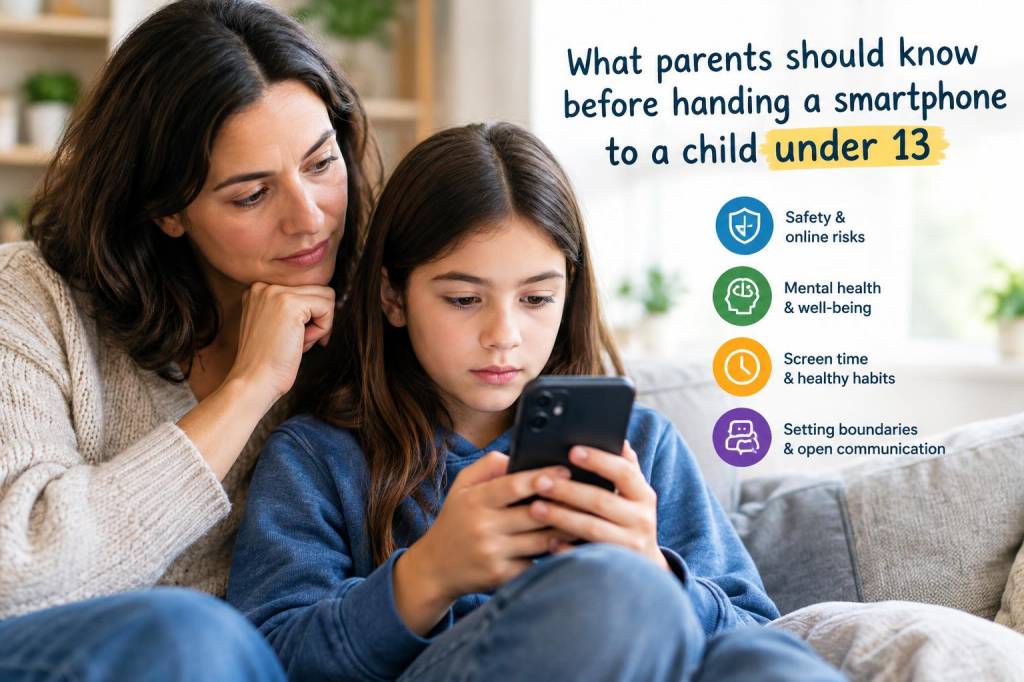
Handing a smartphone to a child under 13 can feel like a small milestone, but I have learned that it is really a family decision with long-lasting effects. A phone is not just a gadget. It is a doorway to messaging, videos, games, social apps, shopping, cameras, location sharing, and a never-ending stream of attention-grabbing content. Before I would ever put one in a child’s hand, I think parents need a clear plan for safety, rules, and follow-through.
I have seen families approach this moment in very different ways. Some treat a phone like a simple communication tool. Others see it as a reward or a marker of growing up. In my view, it works much better when it is treated as a responsibility from day one. A child under 13 may be ready for some features, but very few are ready for full, unsupervised access. What matters most is not just age, but maturity, self-control, and the family habits already in place.
Start with your reason for saying yes
Before I would hand over a smartphone, I would ask myself why my child needs it. Is it for contact after school, safety during travel, coordination with sports practice, or simply because classmates already have one? That answer matters because it shapes everything that comes next. A child who needs a phone for logistics does not necessarily need social media, a public profile, or endless app downloads.
I also think it helps to separate need from want. A child may want a phone because friends have one, but that does not mean they are ready for one. If I were making this decision, I would keep my focus on practical use. Can this phone help my child stay in touch, stay safe, and learn responsibility? If yes, then it may make sense. If not, I would wait.
Choose a device with limits already built in
Not every smartphone should be treated as an open door. I would start with a device and settings that let me control what my child can do. Apple and Android both offer strong parental controls, and I would spend time setting them up before the phone ever leaves my pocket. That means restricting app installs, limiting purchases, controlling screen time, and deciding whether web browsing is allowed.
In many families, a hand-me-down phone is fine, but I would still reset it fully and build it back up with child-friendly rules. If a phone already has old accounts, unknown subscriptions, or lingering apps, it is easier for problems to slip through. I would rather begin with a clean slate. A simpler setup usually works better than a clever one.
| Area | What I would set first | Why it matters |
|---|---|---|
| Screen time | Daily limits and downtime | Helps prevent endless scrolling |
| Apps | Approval for downloads | Stops surprise installs |
| Messages | Known contacts only | Reduces stranger contact |
| Location | Shared with parents only | Supports safety without oversharing |
| Purchases | Password required | Prevents accidental spending |
Privacy must come before popularity
One of the biggest mistakes I see is allowing a child to jump straight into social platforms without a privacy conversation. Under 13, a child may not understand how quickly a post can spread, how much information a photo reveals, or how easy it is for strangers to contact them. I would explain, in plain language, that a phone is not a diary, and a message is not always private once it is sent.
I would also talk about photos and location data. A child may love taking pictures, but those images can reveal school names, home clues, uniforms, routines, and faces of friends who did not agree to be shared. I would keep geotagging off and make sure my child knows never to post full names, addresses, school details, or travel plans. A child does not need to become fearful; they just need to become careful.
If I were setting house rules, I would say that any new app must be approved by an adult, and any app with public posting, direct messages, or live video would be reviewed first. Social spaces are not automatically unsafe, but they are rarely neutral. They come with pressure, comparison, and contact from people a child does not know.
Messages and group chats can become a lot faster than adults expect
Texting can sound harmless, but group chats can move quickly and get messy. A child under 13 may not know when to step away, when to ignore teasing, or when to ask for help. I would want every parent to think about bullying, exclusion, and misunderstanding before allowing a smartphone into daily life. A child may be fine sending messages to a parent or a few trusted friends, yet still be overwhelmed by a noisy class chat.
That is why I would set a rule early: if a message makes a child uncomfortable, they show an adult right away. No punishment for bringing it up. No “just ignore it” response. Children need to know that screenshots, saved messages, and blocked contacts are normal tools, not signs of weakness. I would rather hear about a problem too soon than too late.
I would also make sure my child knows that silence can be a signal. If a friend disappears from a group or receives mean messages, that deserves attention. Phones can amplify kindness, but they can also amplify exclusion. That is part of the lesson.
Money settings are just as important as safety settings
It is easy to focus on screen time and forget spending. Yet phones can open the door to in-app purchases, subscriptions, game currency, premium content, and surprise charges. I would never hand over a phone without locking down payment methods. If a child is old enough for a smartphone, that does not mean they are old enough to make purchases without supervision.
I would also talk about ads. Many children do not realize that a free app may be designed to keep them clicking, tapping, watching, and spending. Even when no money changes hands, attention is still valuable. I try to teach that if an app feels impossible to put down, it is probably working exactly as designed.
Sleep, school, and family time need protection
If I gave a child under 13 a smartphone, I would almost certainly charge it outside the bedroom at night. That one rule protects sleep, reduces sneaking, and prevents late-night messaging from becoming a routine. A phone on a pillow is a temptation machine. It buzzes, flashes, and invites one more minute that often becomes one more hour.
I would also protect homework and meals. My own view is that phones should not dominate the rhythm of the house. If everyone is at the table, everyone should be present. If homework is underway, the phone can wait. Children do better with predictable limits than with vague warnings that no one enforces.
For many families, a simple charging station in a shared area works well. It sends a quiet message: this device belongs to the child, but it is still part of the family system.
Talk before problems begin
I think one of the most useful things parents can do is have regular conversations before anything goes wrong. I would not wait for a bad download, an upsetting message, or a late-night argument. I would talk about what to do if a stranger contacts them, if a friend sends something upsetting, if a pop-up asks for personal information, or if a game pressure feels uncomfortable.
That conversation should include trust and honesty. I would tell my child that if something strange happens, I need them to come to me before they try to fix it alone. Many children hide mistakes because they fear losing the phone. I would want them to understand that reporting a problem is part of being responsible, not a reason to panic.
I would also ask my child to help shape the rules. When children help make the plan, they are more likely to respect it. For example, they might choose screen-free times, agree to app review, or decide which contacts are allowed. A child who feels heard is often more cooperative than a child who feels controlled.
Signs a child may not be ready yet
Even if classmates already have phones, I would pause if I saw certain patterns. If my child struggles to stop using a tablet, fights over limits, hides online behavior, or becomes highly anxious when separated from devices, I would wait. A smartphone can magnify those habits very quickly.
I would also hesitate if my child does not yet respect basic privacy rules, such as knocking before entering, asking before posting a photo, or understanding that some conversations stay private. A phone asks for judgment, and judgment grows over time. Readiness is not only about age; it is about whether a child can handle choices with some consistency.
A simple family contract can prevent a lot of conflict
If I were setting this up in my own home, I would put the rules in writing. Not because children need a legal document, but because clear expectations remove confusion. A short agreement can cover phone hours, app approval, charging location, password sharing, spending rules, and what happens if the rules are broken. It does not need to be harsh. It just needs to be clear.
I would keep it short enough that a child can actually remember it. A long list of impossible rules usually fails. A few firm rules, revisited often, work far better. And I would review the agreement as my child grows. What works at 10 may feel too restrictive at 12, and what feels appropriate at 12 may need revision by 13.
- Set up parental controls before first use
- Allow only approved contacts at first
- Keep location sharing limited to family
- Require adult approval for new apps
- Charge the phone outside the bedroom
- Review photos, messages, and purchases together
- Revisit rules every few months
What matters most to me is not whether a child has a phone, but whether that phone fits into a healthy family life. When parents plan carefully, set real limits, and stay involved, a smartphone can be managed without handing over full independence too early. When they skip the setup, the phone tends to set the rules instead.